
Blogging is not just for storytellers. It is to educate your audience, solve their problems, and improve your brand awareness.
Businesses that blog get 55% more website visitors, according to HubSpot. And for e-commerce websites, every one of those extra visitors could be a potential customer.
But only informing is not enough for SEO-friendly content.
To increase your e-commerce SEO, you need to create blog content that’s search-driven, user-focused, and strategically linked to your offerings.
In this article, I’ll show you 6 practical ways to increase SEO for your online store. It will bring more visitors to your store and improve the conversion rate.
6 ways to write blogs that increase SEO for your e-commerce
Blogging for e-commerce is to create smart, optimized content that ranks your site higher on search engines and drives traffic to your product pages. So more people see your products and you sell more.
The following practices are the best to achieve exactly that.
1. Understand what your customers are searching for
Seth Godin is an American Author and entrepreneur. He says, “Don’t find customers for your products, find products for your customers.”
That advice is gold, especially when it comes to SEO.
It means stop guessing and start figuring out what your ideal customers are already searching for related to your product or service. Look at their search terms (the keywords) to find out what problems they have and what solutions they’re looking for.
SEO research tools, like Semrush and Ahrefs, will help you with that. Look for terms with strong intent, decent search volume, and low competition in the beginning.
Once you know the questions your audience is asking, build your blog content around them. This way, you’re not just creating content, you’re solving real problems.
2. Create content that solves, educates, or inspires
The keywords that we’ve discussed in the previous section are questions waiting to be answered. Your blog should be that answer.
For example, someone is searching for “best skincare routine for dry skin,” and you sell moisturizers. Then don’t just write a product page.
Instead, create a helpful blog post that breaks down the issue and gives real skincare tips. Naturally links to your products as solutions.
To keep it SEO-friendly, make sure you use their keywords within your content. But not in a textbook way, place them naturally.
If you’re unsure how to do that, you can use AI writer tools, like the AI paragraph writer, for this. Provide it with all the keywords you’ve found and the topic, and paragraph-generator.com will create blogs with your keywords naturally placed in the content.
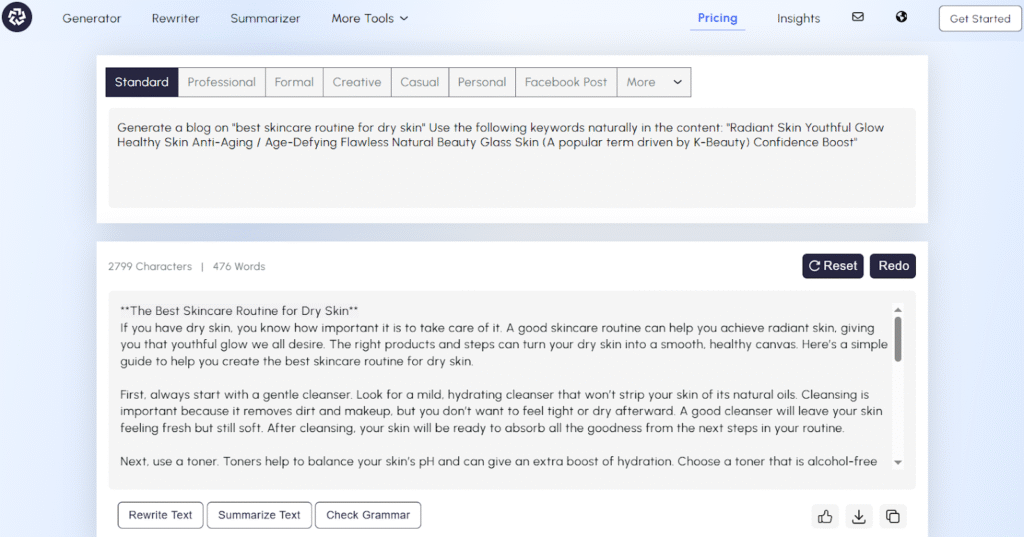
Search engines will see you’re answering the exact query a user types in. They will match your blog with that search. And you get more traffic.
3. Optimize blogs for search engines
Using keywords is just the beginning. To really improve your seo for an e-commerce website, your blogs need to be fully optimized for search engines as well.
And search engines don’t just look at what you say. They also pay attention to how you present it.
That means your blog should be easy to read, scan, and crawl. For that, your structure has to be clean and straightforward. And your writing must be highly readable. Probably below 8th-grade level.
You can easily do that with an AI rewriter tool. You just have to paste your content at rewriteway.com, and it will rewrite it with the simplest of sentences and a better choice of words.

Use bullet points, short paragraphs, headings, and proper spacing. Also, make sure it’s mobile-friendly, because over 60% of users read blogs on their phones.

Source: AIOSEO

Then comes your meta tags.
Your meta title should be under 60 characters, and your meta description under 160 characters. So users can read them fully. Include your main keyword in both of them.
Because if your formatting is messy or your tags are too long, search engine crawlers might ignore parts of your content. This means lost ranking opportunities.
4. Internally link content to product and category pages
Once you start giving useful solutions to your readers, don’t leave them hanging. Link your solutions directly from your product pages. This way, you’re not only offering helpful advice, you’re making it easier for your audience to get it. Fulfilling the end goal.
Let’s say your blog explains “how to choose the right gym shoes.” As you guide the reader through different features, link to your product pages that match those features.
It will be better if you can use a keyword as an anchor text. Even better if the keyword comes in a conversational style. So it does not feel like a promotion at all.
An AI humanizer can help you with that. If you provide it with your text, it will make it look like a human conversation.
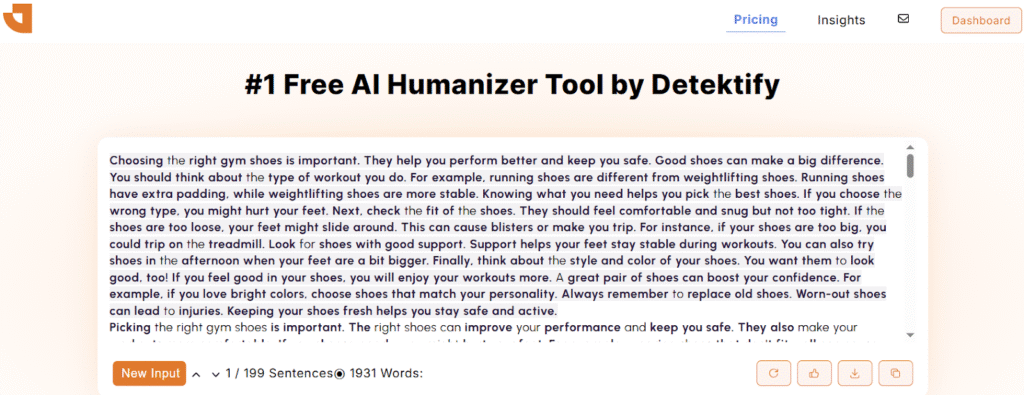
That’s how detektify.com can also bring a human touch to your content.
This improves user experience by giving your readers a clear next step. Plus, search engines crawl your website more efficiently.
5. Add high-quality visuals
No one likes reading a wall of text, especially online shoppers.
You need to add high-quality visuals to your blog content. Like product images, infographics, step-by-step visuals, and even short videos.
They’ll make your blogs more attractive and help explain your content better. Just as it is said, “A picture is worth a thousand words.”
Google also indexes images, so do not forget to add the right alt text and file names. Your product images can also appear in search results.
6. Write consistently and keep content fresh
Writing consistently is one of the most underrated but powerful ways to increase your e-commerce blog’s SEO.
Search engines love fresh content. If you write actively and regularly update your articles, Google sees your site as more current and trustworthy. That means better chances of ranking higher.
But just updating the publish date alone isn’t enough. You also need to keep your content updated.
- Replace outdated stats and info
- Add new internal links to recent products or collections
- Update old blog posts with fresh keywords and search trends
- Refresh your CTAs and offers
If you want to change the writing style as well. You can just use the sentence rewriter tool for that. It offers 15 different styles for rewriting. From academic to persuasive and descriptive.
Just paste your test at sentencerewriter.net, choose one mode, and click “Reword.” You will have your results within seconds.
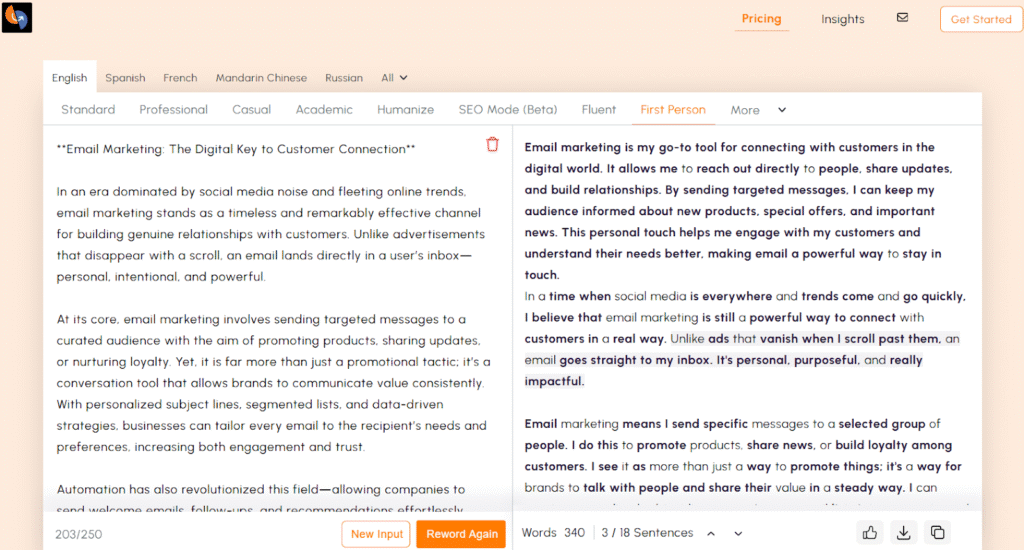
This will help you align your blog content with present-day pain points and search behavior. So your web traffic stays stable.
Conclusion
When blogging is done right, it answers real customer questions and quietly guides readers toward your products.
And that’s not even the best part. Unlike paid ads that stop when your budget runs out, well-optimized blog posts keep working for you day after day.
So, treat your blog like a marketing asset. Analyze what’s working, stay updated with search trends, and always align your content with real searches.
Start small, stay consistent, and let your blog be the silent salesman that never sleeps.